
 Wine Shop
[:it]Da quasi un anno la scansione dei nostri ritmi quotidiani ha subito dei cambiamenti. Chi più, chi meno si ritrova ad avere più tempo “libero”. In questo mese di gennaio, ricco di aspettative e buoni propositi per il nuovo anno, ma anche già stanco dell’inverno che ancora ci aspetta, sono aumentati i momenti in cui ci ritroviamo in casa, in poltrona, magari davanti un camino, ed allora perché non prendere un calice per permettere ai nostri pensieri di liberarsi! Già Socrate e Platone ne esaltavano il potere meditativo. Platone ha intitolato la sua opera Simposio (Sun-posion: etimologicamente ‘bere insieme’) e citiamo: “E non avevamo anche detto che in tali circostanze le anime dei bevitori fondono come il ferro e perciò si fanno più malleabili … alla riflessione…” (Platone, Leggi, 671 B-C).
Ecco perché ci sembra arrivato il momento di raccontarvi qualche “vino da meditazione”. Questo termine fu usato per la prima volta da Luigi Veronelli negli anni ’70 per indicare i vini che per la loro struttura e complessità sono “solisti”, cioè danno il meglio di sé bevuti da soli.
Stiamo parlando quindi di vini dolci, da fine pasto, ma anche dei grandi vini lungamente invecchiati, di vini a maturazione filmogena, di ice wine, di vini liquorosi di lungo affinamento, vini che non hanno bisogno di abbinamenti, vini che esprimono la loro essenza nell’attento ascolto delle loro note.
Ognuno può trovare la sua di interpretazione, resta il fatto oggettivo che questi vini hanno molto da raccontare, tanto quanto il tempo delle uve lasciate a passire o le maturazioni lunghe sui graticci, il modo giusto per degustarli è in totale relax, magari dopo cena con un po’ di musica di sottofondo, siete pronti? Ricordate avrete bisogno di Tempo…
Tempo per dedicarsi ai propri pensieri, o per non pensare affatto.
Tempo per rilassarsi, lasciando il mondo e le preoccupazioni fuori dalla porta.
Tempo per volersi bene, con una piccola coccola.
Non potendo raccontarvi nel dettaglio tutti i vini che potrebbero ispirarci profonde meditazioni ne abbiamo selezionati 2, uno proveniente dalla Francia l’altro proveniente dal ghiaccio.
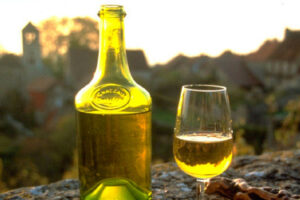
Il Vin Jaune è un vino bianco secco specifico dello Jura, ottenuto da un unico vitigno il Savagnin, invecchiato sotto un velo di lieviti (FLOR). Al termine del periodo di affinamento che dura 6 anni e 3 mesi, il vin jaune viene imbottigliato in una bottiglia appositamente sagomata, della capacità di 62 cl, riservata esclusivamente ai vin jaune denominata: “Clavelin”. La capacità di 62 cl corrisponde al volume di vino rimanente dopo 6 anni di invecchiamento di 1 litro di vino in botti senza rabbocco.
Giallo dorato e con un particolarissimo profumo di ” goût de jaune ” (il sapore di giallo). Il ” goût de jaune ” è una combinazione di note aromatiche di frutta secca, mela, frutta candita e spezie. È un vino molto ricco, molto potente con una lunga persistenza in bocca, lo si ritiene il vino con la PAI più lunga in assoluto. Si tratta di vini con un potenziale di invecchiamento molto lungo (oltre 100 anni).
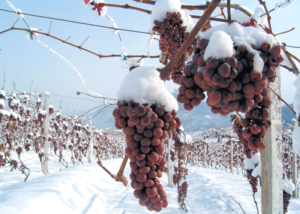
Il Vin de Glace / Eiswein / Ice Wine è una sorta di prodigio della natura. Intensamente dolce, con aromi esplosivi e sapori di frutta, è un prodotto raro perché di non facile realizzazione.
Viene prodotto principalmente in Canada, dove prende il nome di Ice Wine, in Germania e Austria, dove è conosciuto con il termine Eiswein: questi sono paesi e regioni dove le temperature sono sufficientemente fredde perché le uve si congelino rapidamente. La temperatura ideale: tra -7 ° C e -10 ° C. La raccolta dell’uva congelata è fatta a mano: i grappoli devono essere integri al momento della pressatura, il ghiaccio non deve sciogliersi … Spesso è quindi necessario vendemmiare di notte, quando le temperature sono le più basse.
Bianco o rosso, è un vino che si distingue per l’elevato contenuto zuccherino. La seconda caratteristica è il sapore intensamente fruttato dove spiccano gli aromi primari dell’uva, con tavolozze aromatiche che vanno dalla frutta fresca (mela, agrumi, albicocca, uva, pesca, ananas …) alla frutta secca e alle confetture di frutta (uva passa, albicocche secche, caramello, fico.). Gli aromi poi dipendono ovviamente dal vitigno utilizzato (Vidal/Canada, Riesling/Germania, Grüner Veltliner/Austria). La terza caratteristica è l’acidità, il lato rinfrescante e piccante dei vini ghiacciati. Questa acidità proviene dall’uva allo stesso modo dello zucchero: quando l’uva perde la sua acqua per congelamento, la concentrazione di zucchero e acidi aumenta proporzionalmente.
Con l’augurio di aver stuzzicato la vostra fantasia, vi diamo appuntamento al prossimo articolo lasciandovi piacevolmente assorti in medi(degus)tazione.[:en]For almost a year, our daily rhythms has undergone substantial changes. Some people find themselves having more “free” time, some others less. In this month of January, full of expectations and good resolutions for the new year, but also already tired of the winter ahead, the moments in which we find ourselves at home, sitting on an armchair, perhaps next to fireplace, have increased. Then why not taking a glass of wine to allow our thoughts to free themselves?! Socrates and Plato already exalted its meditative power. Plato entitled his work Symposium (Sun-posion: etymologically ‘drinking together’) and then: “And we had not also said that in such circumstances the souls of drinkers melt like iron and therefore become more malleable … to reflection …” (Plato, Laws, 671 BC).
This is why the time has come to tell you about some “meditation wine”. This term was used for the first time by Luigi Veronelli in the 1970s to indicate wines that, due to their structure and complexity, are “soloists”, that is, they give their best when drunk alone.
We are therefore talking about sweet wines to enjoy at the end of a meal, but also about great wines aged for a long time, wines with film-forming maturation, ice wines, long-aged fortified wines, wines that do not need to be matched, wines that express their essence in attentive listening to their notes.
Everyone can find their own interpretation. The objective fact remains that these wines have a lot to tell. As much as the time of the grapes left to dry or the long maturation on racks, the right way to taste them is in total relaxation, perhaps after dinner with some background music. Are you ready? Remember you will need time …
Time to devote yourself to your thoughts, or not to think at all.
Time to relax, leaving the world and worries outside the door.
Time to love and treat yourself.
Not being able to tell you in detail all the wines that could inspire deep meditations, we have selected 2, one from France and the other from ice.
Vin Jaune is a specific dry white wine from the Jura, obtained from a single vine, the Savagnin, aged under a veil of yeast (FLOR). At the end of the aging period which lasts 6 years and 3 months, the vin jaune is bottled in a specially shaped bottle, with a capacity of 62 cl, reserved exclusively for vin jaune called: “Clavelin”. The 62 cl capacity corresponds to the volume of wine remaining after 6 years of aging of 1 liter of wine in barrels without topping up.
Golden yellow and with a very particular scent of “goût de jaune” (the taste of yellow). The “goût de jaune” is a combination of aromatic notes of dried fruit, apple, candied fruit and spices. It is a very rich wine, very powerful with a long persistence in the mouth. It is considered the wine with the longest PAI (Intense Aromatic Persistence) ever. These are wines with a very long aging potential (over 100 years).
Vin de Glace / Eiswein / Ice Wine is a kind of prodigy of nature. Intensely sweet, with explosive aromas and fruit flavors, it is a rare product because it is not easy to make.
It is mainly produced in Canada, where it takes the name of Ice Wine, in Germany and Austria, where it is known by the term Eiswein: these are countries and regions where temperatures are cold enough for the grapes to freeze quickly. The ideal temperature: between -7 ° C and -10 ° C. The harvest of frozen grapes is done by hand: the bunches must be intact at the time of pressing, the ice must not melt. It is therefore often necessary to harvest at night, when temperatures are the lowest.
White or red, it is a wine that stands out for its high sugar content. The second characteristic is the intensely fruity flavor where the primary aromas of the grapes stand out, with aromatic palettes ranging from fresh fruit (apple, citrus, apricot, grape, peach, pineapple …) to dried fruit and fruit jams (raisins, dried apricots, caramel, fig.). The aromas then obviously depend on the grape variety used (Vidal / Canada, Riesling / Germany, Grüner Veltliner / Austria). The third characteristic is acidity, the refreshing and spicy side of iced wines. This acidity comes from grapes in the same way as sugar: when grapes lose their water by freezing, the concentration of sugar and acids increases proportionally.
With the hope of having whetted your imagination, we give you an appointment for the next article, leaving you pleasantly absorbed in meditation wine tasting.[:fr]Depuis près d’un an, l’organisation de nos rythmes quotidiens a bien changé. Certains plus, d’autres moins, nous avons plus de temps “libre”. En ce mois de janvier, qui est plein d’attentes et de bonnes résolutions pour la nouvelle année, mais qui est aussi déjà fatigué de l’hiver qui nous attend , nous vivons bien des moments où l’on se retrouve chez soi, dans un fauteuil, peut-être devant une cheminée, et alors pourquoi ne pas nous offrir un bon verre de vin pour permettre à nos pensées de se libérer ! Socrate et Platon exaltaient déjà sa puissance méditative. Platon a intitulé son œuvre Symposium (Sun-posion: étymologiquement «boire ensemble») nous citons: «Et nous n’avions pas dit aussi que dans de telles circonstances les âmes des buveurs fondent comme du fer et deviennent donc plus malléables … . “(Platon, Lois, 671 avant JC).
Nous voilà au sujet de cet article : le “vin de méditation”. Ce terme a été utilisé pour la première fois par Luigi Veronelli dans les années 1970 pour désigner des vins qui, en raison de leur structure et de leur complexité, sont des «solistes», c’est-à-dire qu’ils s’expriment le mieux à être bu seuls.
On parle donc des vins doux, mais aussi de grands vins affinés longtemps, des vins sous voile, des vins de glace, des vins de liqueur à long vieillissement, des vins qui n’ont pas besoin d’accords, des vins qui nous expriment leur vrai nature seulement si on écoute attentivement leurs notes.
Chacun peut utiliser sa propre clef de lecture, l’évidence reste que ces vins ont beaucoup à nous raconter, autant le temps de séchage des raisins ou la longue maturation sur les casiers, la meilleure façon de les déguster est en totale détente, peut-être après le dîner avec une musique de fond, êtes-vous prêt? N’oubliez pas que vous aurez besoin de temps …
Il est temps de vous consacrer à vos pensées ou de ne pas penser du tout…
Il est temps de se détendre, de laisser le monde et les soucis en dehors de la porte…
Il est temps de s’aimer soi-même, avec un petit câlin…
Il est impossible de parler de tous les vins qui pourraient inspirer de profondes méditations, nous en avons sélectionnés 2, un qui vient de France et l’autre qui vient de la glace.
Le Vin Jaune est un vin blanc sec spécifiquement jurassien, issu du seul cépage Savagnin, élevé sous voile de levures, à l’issue de la période d’élevage (6ans et 3 mois), le vin jaune est embouteillé dans une bouteille à la forme particulière, d’une contenance de 62 cl, exclusivement réservée aux vins jaunes appelée : “Clavelin” . La contenance de 62 cl correspond au volume de vin restant après 6 années d’élevage de 1 litre de vin en fût sans ouillage.
Ce vin à la robe jaune d’or et à l’arôme très particulier de « goût de jaune ». Le « goût de jaune » est une combinaison de notes aromatiques de noix, de pomme, de fruits confits et d’épices. Ce sont des vins de très longue garde (plus de 100 ans).
Le Vin de Glace/Eiswein/Ice Wine est une forme de prodige de la nature. Intensément sucré, avec des arômes et saveurs de fruits explosifs, il reste cependant un produit rare, notamment parce qu’il n’est pas facile à produire.
On en produit essentiellement au Canada, où il est appelé Ice Wine, en Allemagne et en Autriche, où on le connaît sous le terme Eiswein : ce sont des pays et régions où les températures sont suffisamment froides pour que les raisins gèlent rapidement. La température idéale : entre -7°C et -10°C. La vendange des raisins gelés se fait à la main : les grappes doivent être intactes au moment du pressage, la glace non fondue… Il faut donc souvent vendanger de nuit, quand les températures sont les plus basses et que le raisin ne risquera aucun dommage sur la route entre la vigne et les chais !
Blanc ou rouge, c’est un vin qui se distingue par sa richesse en sucre. La deuxième caractéristique est la saveur intensément fruitée des vins de glace. Les arômes primaires de raisin ressortent, avec des palettes aromatiques allant des fruits frais (pomme, agrumes, abricot, raisin, pêche, ananas…) aux fruits séchés et confitures de fruits (raisins secs, abricots secs, caramel, figue…). Les arômes dépendent alors du cépage utilisé (Vidal/Canada, Riesling/Allemagne, Grüner Veltliner/Autriche).La troisième caractéristique est l’acidité, le côté rafraîchissant acidulé des vins de glace. Cette acidité vient des raisins au même titre que le sucre : quand le raisin perd son eau par le gel, la concentration en sucre et en acides augmente proportionnellement.
[:]
